EigenSafe is a novel operator-theoretic framework designed to assess the safety of stochastic robotic systems.
The framework derives a linear operator that governs the evolution of the safety probability over long time horizons.
The dominant eigenpair of this operator is used as a calibrated safety critic: the dominant eigenvalue serves as a global safety metric for the policy, and the dominant eigenfunction acts as a state-wise safety score.
The approach is validated in two distinct domains: enforcing safety constraints in reinforcement learning (RL) for continuous control tasks and providing test-time safety filtering for imitation learning (IL) in robotic manipulation.
The Spectral Framework
The Dominant Eigenfunction as a Calibrated Safety Critic
The evolution of safety probability follows a dynamic programming principle, where the safety probability at the current time step is the expection of the next-step safety probability. We frame this recursive update as a linear operator acting on functions of state-action pairs. The system's asymptotic safety behavior is described by its dominant eigenpair, yielding a metric that is calibrated to the true safety probability.
The eigenpair loss term enforces the eigenfunction to satisfy the eigenvalue equation, and the normalization loss prevents trivial solutions by constraining the maximum value of $\psi$ to be 1. The learned eigenpair can be used as a calibrated safety critic for policy optimization or test-time safety filtering.
Application 1: Safe Reinforcement Learning
We optimize a policy that maximizes the expected discounted sum of rewards subject to a spectral constraint on the eigenvalue ($\gamma_\pi \geq \gamma_{target}$), ensuring the policy remains safer than a specified threshold. We validate this approach in four (customized) gym environments: CheetahLow, HopperHigh, LunarLanderHard, and AntBall.
The CheetahLow environment is a modified version of the standard HalfCheetah environment. The agent receives reward based on its forward velocity only, and the safety constraint is defined as maintaining the height of the torso below a certain threshold.
Constraint satisfaction is indicated by the color of the floating ball.
EigenSafe (Proposed method)
(1) Vanilla SAC (Haarnoja et al., 2018)
(2) RESPO (Ganai et al., 2023)
(3) EFPPO (So et al., 2023)
HopperHigh
The HopperHigh environment is a modified version of the standard Hopper environment. The agent receives reward based on its forward velocity only, and the constraint is to maintain the height of the torso above a certain threshold.
Constraint satisfaction is indicated by the color of the floating ball.
EigenSafe (Proposed method)
(1) Vanilla SAC (Haarnoja et al., 2018)
(2) RESPO (Ganai et al., 2023)
(3) EFPPO (So et al., 2023)
LunarLanderHard
The LunarLanderHard environment is a more challenging variant of the standard LunarLander environment, with diversified initial reset states. The reward is given only for successful landing, and the safety constraints are imposed on landing velocity, body orientation, and horizontal position.
Constraint satisfaction is indicated by the color of video frame.
EigenSafe (Proposed method)
(1) Vanilla SAC (Haarnoja et al., 2018)
(2) RESPO (Ganai et al., 2023)
(3) EFPPO (So et al., 2023)
AntBall
The AntBall environment is a modified version of the standard MuJoCo Ant environment. The agent receives reward based on its forward velocity only, and the safety constraint is to not drop the ball from the plate attached on the torso.
Constraint satisfaction is indicated by the color of the floating ball.
EigenSafe (Proposed method)
(1) Vanilla SAC (Haarnoja et al., 2018)
(2) RESPO (Ganai et al., 2023)
(3) EFPPO (So et al., 2023)
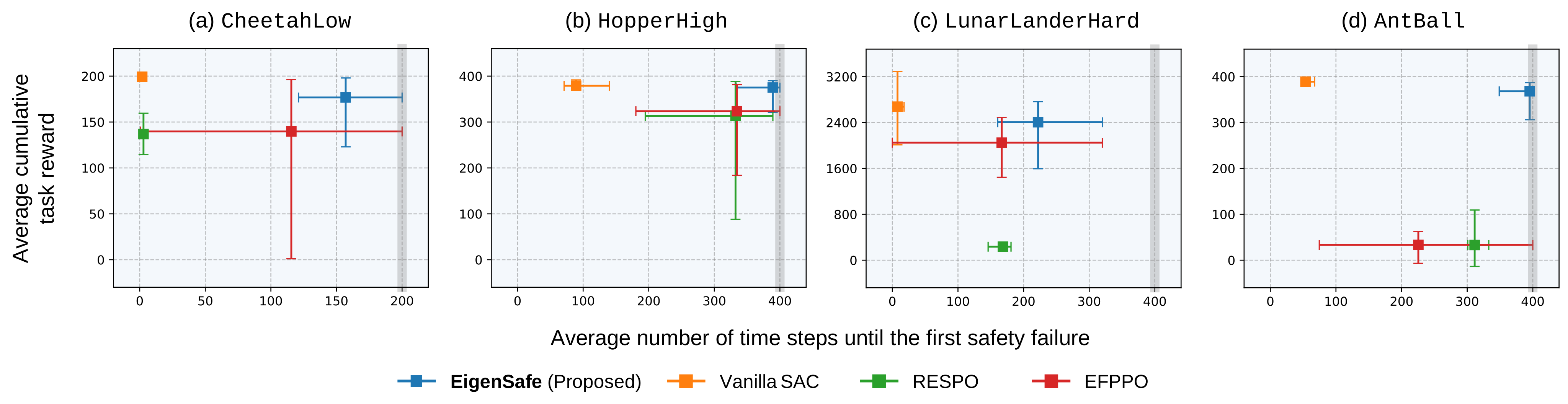
The proposed method consistently achieves higher reward with better constraint satisfaction across all environments, compared to the baselines.
Figure. Baseline comparison results for safe RL using EigenSafe. The horizontal axis denotes the number of timesteps taken until a safety failure or the agent has reached the maximum episode length, and the vertical axis denotes the total undiscounted episode reward. The error bars denote minimum, average, and maximum values over four random seeds. Gray vertical bars denote the maximum episode length.
Application 2: Safety-Filtered Imitation Learning
We apply EigenSafe to a stochastic behavior cloning policy on a UR3 robot in a food preparation task. At test time, we sample multiple ($n$) action candidates and select the one with the $k$-th highest eigenfunction value (higher safety critic value).
Video. Safety-filtered IL using EigenSafe. ($k=10$, $n=50$)
Video. Baseline IL (flow policy model) without safety filtering.
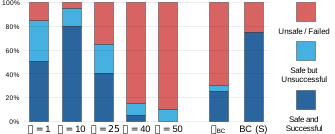
Figure. Success/safety rates in safety-filtered IL ($n=50$). There is a positive correlation between the selecting actions with higher $\psi_\pi$ values and the success/safety rates, except for the $k=1$ case where the action is subject to the risk of being out of distribution.
Abstract
We present EigenSafe, an operator-theoretic framework for safety assessment of learning-enabled stochastic systems. In many robotic applications, the dynamics are inherently stochastic due to factors such as sensing noise and environmental disturbances, and it is challenging for conventional methods such as Hamilton-Jacobi reachability and control barrier functions to provide a well-calibrated safety critic that is tied to the actual safety probability. We derive a linear operator that governs the dynamic programming principle for safety probability, and find that its dominant eigenpair provides critical safety information for both individual state-action pairs and the overall closed-loop system. The proposed framework learns this dominant eigenpair, which can be used to either inform or constrain policy updates. We demonstrate that the learned eigenpair effectively facilitates safe reinforcement learning. Further, we validate its applicability in enhancing the safety of learned policies from imitation learning through robot manipulation experiments using a UR3 robotic arm in a food preparation task.
BibTeX
@article{jang2026eigensafe,
title={EigenSafe: A Spectral Framework for Learning-Based Probabilistic Safety Assessment},
author={Jang, Inkyu and Park, Jonghae and Cho, Sihyun and Mballo, Chams E and Tomlin, Claire J and Kim, H Jin},
journal={arXiv preprint arXiv:2509.17750},
year={2026}
}